Thursday, June 26, 2008

World Abalone Farming

Worldwide there are over sixty species of abalone, half of which are harvested commercially. Countries with a larger abalone fishery include Japan, Australia, New Zealand, South Africa, Korea, Taiwan and China. Reductions in the world catch have been reduced from 50 to 95 percent over the past twenty five years.

Typical Problems For Abalone Farmers/Corporations

  • A technology is developed to farm an abalone species. Changes in technology over time are more provincial rather than on a world scale. Farmers often unnecessarily torment themselves through many years of losing money and endless cuts and bruises.
  • Once the species is considered commercially viable to produce and production rises, a series of market questions begin, such as, "Why isn't the product accepted as quickly as we anticipated in the marketplace? Why is our price lower than our projections?" Often there is no marketing program in place with a worldwide prospective.
  • Long after commercial production of a particular species is in the upswing cycle regrettably, the serious marketing strategy begins. The species is almost never market driven for long periods of time while the production escalates.

The future of world abalone prices will be affected by factors on both the supply and demand sides of the market - -but within a limited range, remaining highly profitable for abalone farms taking advantage of changing world wide technology and developing experienced marketing programs.


Abalone aquaculture, even at its growing pace will take many years to fill the declining supply of the world' wild abalone fisheries. (see charts above) With quickly expanding world abalone farming production, we will see some profitability decline for those operations not utilizing appropriate technology and not developing worldwide marketing programs.

2007 Worldwide Abalone Farming Production

  • California, USA: There are currently 13 abalone farms on the coast of California The farmed size is normally 75 to 100mm and they are available live or processed. The largest farm produces over 100 tons and the smaller less than 10tons.
  • Japan: Japan has many major seed farming operations, most of which are involved in ocean enhancement, totals of which are included under Fisheries. 30 to 40 million seeds are planted annually. Almost all Japanese farming consists of ocean bottom growing from farmed seeds.
  • China: China is the worlds largest producer with over 300 abalone farms with production expected to produce over 26,000mt in 2007, excluding lower value species. Most production is consumed within China.
  • Korea: Total production in 2007 is anticipated at over 4,000mt.
  • Taiwan: Taiwan currently has over 400 farms (many are small family run operations). Total production in 2007 is anticipated at over 4,000 tons, including lower value species. Most Production is consumed in Taiwan.
  • Thailand: Newest and fastest growing farming nation. Mostly H.diversicolor supertexta .
  • Australia/New Zealand: Farmed production is estimated at 600mt in 2007 This total reflects the current virus problems in Australia.
  • Chile and South Africa: Combined production should exceed 1,000 metric tons in 2007 mostly H.rufescens and H.midae.
  • Miscellaneous Countries: In combination, all of Europe, Iceland and Pacific Rim countries should have a farm production of over 300 metric tons in 2007.

http://www.fishtech.com/farming.html

Wednesday, June 25, 2008

Sony BRAVIA KDL-40V3000 40" LCD TV

Display Type: LCD

Display Format: 1080p (HDTV)

Input: A/V (Composite),
Audio - Line In (1/8" Mini),
Coaxial (RF),
Component Video,
HDMI,
S-Video,
SCART,
VGA

Output: Audio - Line Out (1/8" Mini),
SCART,
Variable/Fixed Audio

Aspect Ratio: 16:9

Slots: PC card (Type not specified)

Resolution: 1920 x 1080

Freeview (DVB-T) Tuner: Yes

Brightness: 500 cd/m2

Diagonal Screen Size: 40
Display Panel

Static Contrast Ratio: 1800:1

Brightness: 500 cd/m2

Response Time: 8 ms

Contrast Ratio: 16000:1

Resolution: 1920 x 1080

Diagonal Screen Size: 40 in

Viewable Size: 102 cm

Aspect Ratio: 16:9

Display Type: LCD
Broadcast Standards

Freeview Tuner: Yes

HDTV Compatible: Yes

Broadcast Format Supported: 1080i (HDTV),
1080p (HDTV),
480i (SDTV),
480p (EDTV),
576i,
576p,
720p (HDTV)

Broadcast Format Displayed: 1080p (HDTV)
Interface

Slots: PC card (Type not specified)

Output: Audio - Line Out (1/8" Mini),
SCART,
Variable/Fixed Audio

Input: A/V (Composite),
Audio - Line In (1/8" Mini),
Coaxial (RF),
Component Video,
HDMI,
S-Video,
SCART,
VGA
Picture Features

Vertical Viewing Angle: 178 degrees

Horizontal Viewing Angle: 178 degrees

Picture in Picture: Single Tuner PIP

Comb Filter: 4-Line Digital (3D Motion Adaptive)
Other Features

Remote Control: Basic Remote

Included Components: Speakers,
Stand

Audio Format Supported: NICAM Stereo,
Stereo

General Features: Headphone Jack,
Multi-Language Menu,
Progressive Scan
Physical Specifications

Weight: 24 kg

Depth: 265 mm

Width: 992 mm

Height: 688 mm

Mounting: Desktop,
Wallmount

http://electronics.pricegrabber.co.uk/plasma-lcd-televisions/m/50584385/details/st=product_tab/

Achiever Black & White Hi-Tech A/V Security Video Camera

Achiever Black & White Hi-Tech A/V Security Video Camera 00760

Achiever Black & White Hi-Tech A/V Security Video Camera 00760

Achiever Black & White Hi-Tech A/V Security Video Camera 00760


The ideal camera for indoor use! This Achiever black and white security video camera can be used a variety of ways; for surveillance, in retail stores & offices and for your home. The security camera can be easily mounted to walls and ceilings and it connects to a TV, VCR, and closed circuit televisions.

The security camera features an adjustable lens and works great in low light. Get Hi-Tech audio and video security at an affordable price with this black and white security camera! Order today!


Features/Specifications:
  • Achiever Black & White Hi-Tech A/V Security Video Camera

  • General Features:
  • Black and White Security camera
  • Ideal for Home or Office use
  • Mounts easily to walls and ceilings
  • Audio and Video capability
  • 60 feet of camera cable with RCA plugs included
  • Can be used in low light
  • Connects to a VCR for recording purposes
  • Connects to all TV's with input jacks
  • Adjustable lens

  • Specifications:
  • Integrated Lens: 3.6 mm F2.0 fixed focus
  • Resolution: 420 lines
  • Power consumption: 1.3 Watts
  • Auto IRIS shutter: 1/60 ~ 1/100,000
  • Signal/Noise Ratio: 46dB
  • Image Sensor: 1/3" CCD
  • Min. Illumination: 0.5 Lux

  • Regulatory Approvals:
  • UL
Package Includes:
  • Achiever Black & White Hi-Tech A/V Security Video Camera
  • Camera mounting bracket
  • 60 foot camera cable
  • AC Adapter (120V 60Hz)
  • Mounting hardware
  • Instruction sheet
Additional Information:

  • Requirements:
  • Available power outlet
  • A/V monitor

  • Notes:
  • Model: 00760
  • UPC Code: 7 15067 00760 1

http://www.geeks.com/details.asp?InvtId=00760&cpc=RECOM

Monday, June 23, 2008

Introducing The International Tesla Electric Company

ITEC's Free Electricity Program

Utility Company of Better World Technologies

Nikola Tesla

Please Note The Facts:

Better World Technologies (BWT) believes they have the ability to produce an electric generator that will produce more electricity than it will consume, thus Free Electricity. BWT conducted a nationwide tour in 1999 to demonstrate one half of this technology the Hummingbird Motor (the driver) proven to be 100% efficient. In 2001 BWT conducted another nationwide tour to demonstrate the second half of this technology, the Sundance Generator, proven to produce five units of mechanical energy for each unit consumed (1 in 5 out). Both tours were heavily advertised and invited anyone to bring their own test equipment to disprove the above technologies - Many experts came and NOT ONE disproved either technology (all demonstrations were video taped).

Better World Technologies further believes they can combine the Hummingbird Motor with the Sundance Generator to produce "Free Electricity". BWT does not claim to have a Free Electricity generator and have not, to date, combined the Hummingbird to the Sundance. Due to the suppression of technology by Corporate America, BWT will not come forward until a critical mass of public awareness is achieved. Once 1.6 million people of North America has been registered for this program and agreed to be a witness at our demonstrations, BWT will produce 100 units to be demonstrated nationwide. These demonstrations will be held at the same time across America in sports stadiums and large public meeting places.

In appreciation to these first 1.6 million witnesses, the International Tesla Electric Company (BWT's utility company) will provide up to 26,000 kWh of free electricity per year for as long as ITEC is able to sell the excess electricity on the open market. This is our way of rewarding these witnesses for their faith in God, His technology and us. After the technology has been publicly demonstrated and proven to the world the remaining 14.4 million units planned for distribution to North America will be made available to the public at a projected cost of $2,000.00 per registrant.

The unit is not now for sale and will never be made available for sale but will remain the property of BWT and ITEC. Those fortunate enough to be registered with ITEC will receive the 26,000 kWh per year absolutely free for as long as ITEC is able to sell the excess electricity on the open market.

There are three options to register now as a witness, this offer will be withdrawn without prior notice once BWT announces it has achieved the initial 1.6 million witness goal and the initial demonstrations will be scheduled. All registrants will be notified by mail of the time and date of the demonstration closest to their location. We thank you for your patience, your faith and your support, there is a periodic update you may subscribe to here authored by this UCSA dealer. There is also a periodic updated phone recording by Dennis Lee you may listen to at 212-461-8738.

The details of our current offer follows...


UPDATE: Yes the "Free Electricity" program is still very much alive and all registrants The International Tesla Electric Corporation (ITEC) has current contact information for will be taken care of. The public demonstrations will happen on July 10th of 2009! If not yet registered for ITEC's Free Electricity Program now is the time to do so...


http://bwt.jeffotto.com/free_electricity/free_electricity.htm

LHC MACHINE OUTREACH

LHC - the aim of the exercise:

To smash protons moving at 99.999999% of the speed of light into each other and so recreate conditions a fraction of a second after the big bang. The LHC experiments try and work out what happened.

The Large Hadron Collider (LHC) is being built in a circular tunnel 27 km in circumference. The tunnel is buried around 50 to 175 m. underground. It straddles the Swiss and French borders on the outskirts of Geneva.

It planned to circulate the first beams in May 2008. First collisions at high energy are expected mid-2008 with the first results from the experiments soon after.

The LHC is designed to collide two counter rotating beams of protons or heavy ions. Proton-proton collisions are foreseen at an energy of 7 TeV per beam.

  • The beams move around the LHC ring inside a continuous vacuum guided by magnets.

  • The magnets are superconducting and are cooled by a huge cryogenics system. The cables conduct current without resistance in their superconducting state.


http://lhc-machine-outreach.web.cern.ch/lhc-machine-outreach/

Large Hadron Collider

The Large Hadron Collider (LHC) is a particle accelerator of the European Organization for Nuclear Research (CERN) that lies under the Franco-Swiss border near Geneva, Switzerland. The LHC is in the final stages of construction and commissioning, with some sections already being cooled down to their final operating temperature of approximately 2K. The first beams were due for injection mid June 2008 with the first collisions planned to take place 2 months later.[1] The LHC will become the world's largest and highest-energy particle accelerator.[2] The LHC is being funded and built in collaboration with over two thousand physicists from thirty-four countries as well as hundreds of universities and laboratories.

When activated, it is theorized that the collider will produce the elusive Higgs boson, the observation of which could confirm the predictions and "missing links" in the Standard Model of physics and could explain how other elementary particles acquire properties such as mass.[3][2] The verification of the existence of the Higgs boson would be a significant step in the search for a Grand Unified Theory, which seeks to unify three of the four known fundamental forces: electromagnetism, the strong nuclear force and the weak nuclear force, leaving out only gravity. The Higgs boson may also help to explain why gravitation is so weak compared to the other three forces. In addition to the Higgs boson, other theorized novel particles that might be produced, and for which searches[4] are planned, include strangelets, micro black holes, magnetic monopoles and supersymmetric particles.[5]

Technical design

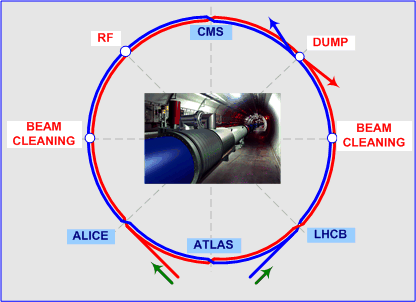
Superconducting quadrupole electromagnets are used to direct the beams to four intersection points where interactions between protons will take place.

The collider is contained in a circular tunnel with a circumference of 27 kilometres (17 mi) at a depth ranging from 50 to 175 metres underground.[6] The tunnel, constructed between 1983 and 1988,[7] was formerly used to house the LEP, an electron-positron collider.

The 3.8 metre diameter, concrete-lined tunnel crosses the border between Switzerland and France at four points, although most of its length is inside France. The collider itself is underground, with surface buildings holding ancillary equipment such as compressors, ventilation equipment, control electronics and refrigeration plants.

The collider tunnel contains two pipes, each pipe containing a beam. The two beams travel in opposite directions around the ring. 1232 dipole magnets keep the beams on their circular path, while additional 392 quadrupole magnets are used to keep the beams focused, in order to maximize the chances of interaction between the particles in the four intersection points, where the two beams will cross. In total, over 1600 superconducting magnets are installed, with most weighing over 27 tonnes. 96 tonnes of liquid helium is needed to keep the magnets at the operating temperature.[8]

The protons will each have an energy of 7 TeV, giving a total collision energy of 14 TeV. It will take less than 90 microseconds for an individual proton to travel once around the collider. Rather than continuous beams, the protons will be "bunched" together, into 2,808 bunches, so that interactions between the two beams will take place at discrete intervals never shorter than 25 ns apart. When the collider is first commissioned, it will be operated with fewer bunches, to give a bunch crossing interval of 75 ns. The number of bunches will later be increased to give a final bunch crossing interval of 25 ns.[9]

LHC Accelerators
LHC Accelerators

Prior to being injected into the main accelerator, the particles are prepared through a series of systems that successively increase the particle energy levels. The first system is the linear accelerator Linac 2 generating 50 MeV protons which feeds the Proton Synchrotron Booster (PSB). Protons are then injected at 1.4 GeV into the Proton Synchrotron (PS) at 26 GeV. Finally the Super Proton Synchrotron (SPS) is used to increase the energy of protons up to 450 GeV.

The LHC will also be used to collide lead (Pb) heavy ions with a collision energy of 1,150 TeV. The ions will be first accelerated by the linear accelerator Linac 3, and the Low-Energy Injector Ring (LEIR) will be used as an ion storage and cooler unit. The ions then will be further accelerated by the Proton Synchrotron (PS) and Super Proton Synchrotron (SPS) before being injected into LHC ring, where they will reach an energy of 2.76 TeV per nucleon.

Six detectors are being constructed at the LHC, located underground in large caverns excavated at the LHC's intersection points. Two of them, ATLAS and CMS, are large, "general purpose" particle detectors.[2] ALICE is a large detector designed to study the properties of quark-gluon plasma looking at the debris of heavy ion collisions. The other three (LHCb, TOTEM, and LHCf) are relatively smaller and more specialized. A seventh experiment, FP420 (Forward Physics at 420m), has been proposed which would add detectors to four available spaces located 420m on either side of the ATLAS and CMS detectors.[10]

The size of the LHC constitutes an exceptional engineering challenge with unique safety issues. While running, the total energy stored in the magnets is 10 GJ, while each of the two beams carries an overall energy of 362 MJ. For comparison, 362 MJ is the kinetic energy of a TGV running at 157 km/h (98 mph), while 724 MJ, the total energy of the two beams, is equivalent to the detonation energy of approximately 173 kilograms (380 lb) of TNT, and 10 GJ is about 2.4 tons of TNT. Loss of only 10−7 of the beam is sufficient to quench a superconducting magnet, while the beam dump must absorb an energy equivalent to a typical air-dropped bomb.

These immense kinetic energies become far more spectacular when you consider how little matter is carrying it. At its maximum energy rating (2.76TeV per particle with a total of 362MJ), there is just 1.15E-9 grams of hydrogen in the system (or 0.026 of one cubic millimeter).

http://en.wikipedia.org/wiki/Large_Hadron_Collider

Large Hadron Collider Countdown

Welcome to LHCountdown.com, this site is primarily a countdown site to the activation of the Large Hadron Collider (for more information on the LHC click here) but is also a hub collecting all articles relating to and about the LHC.

http://www.lhcountdown.com/

Saturday, June 21, 2008

Chromosomes in prokaryotes

The prokaryotes - bacteria and archaea - typically have a single circular chromosome, but many variations do exist.[13] Most bacteria have a single circular chromosome that can range in size from only 160,000 base pairs in the endosymbiotic bacteria Candidatus Carsonella ruddii,[14] to 12,200,000 base pairs in the soil-dwelling bacteria Sorangium cellulosum.[15] Spirochaetes of the genus Borrelia are a notable exception to this arrangement, with bacteria such as Borrelia burgdorferi, the cause of Lyme disease, containing a single linear chromosome.[16]

Structure in sequences

Prokaryotes chromosomes have less sequence-based structure than eukaryotes. Bacteria typically have a single point (the origin of replication) from which replication starts, while some archaea contain multiple replication origins.[17] The genes in prokaryotes are often organised in operons, and do not contain introns, unlike eukaryotes.


DNA packaging

Prokaryotes do not possess nuclei, instead their DNA is organized into a structure called the nucleoid.[18] The nucleoid is a distinct structure and occupies a defined region of the bacterial cell. This structure is however dynamic and is maintained and remodeled by the actions of a range of histone-like proteins, which associate with the bacterial chromosome.[19] In archaea, the DNA in chromosomes is even more organized, with the DNA packaged within structures similar to eukaryotic nucleosomes.[20][21]

Bacterial chromosomes tend to be tethered to the plasma membrane of the bacteria. In molecular biology application, this allows for its isolation from plasmid DNA by centrifugation of lysed bacteria and pelleting of the membranes (and the attached DNA).

Prokaryotic chromosomes and plasmids are, like eukaryotic DNA, generally supercoiled. The DNA must first be released into its relaxed state for access for transcription, regulation, and replication.

http://en.wikipedia.org/wiki/Chromosome

Male chromosome may have a future after all

The human Y chromosome — the DNA chunk that makes a man a man — has lost so many genes over evolutionary time that some scientists have suspected it might disappear in 10 million years. But a new study says it’ll stick around.

Researchers found no sign of gene loss over the past 6 million years, suggesting the chromosome is “doing a pretty good job of maintaining itself,” said researcher David Page of the Whitehead Institute for Biomedical Research in Cambridge, Mass.

That agrees with prior mathematical calculations that suggested the rate of gene loss would slow as the chromosome evolved, Page and study co-authors note in Thursday’s issue of the journal Nature. And, they say, it clashes with what Page called the “imminent demise” idea that says the Y chromosome is doomed to extinction.

The Y appeared 300 million years ago and has since eroded into a dinky chromosome, because it lacks the mechanism other chromosomes have to get rid of damaged DNA. So mutations have disabled hundreds of its original genes, causing them to be shed as useless. The Y now contains only 27 genes or families of virtually identical genes.

In 2003, Page reported that the modern-day Y has an unusual mechanism to fix about half of its genes and protect them from disappearing. But he said some scientists disagreed with his conclusion. The new paper focuses on a region of the Y chromosome where genes can’t be fixed that way.

http://www.msnbc.msn.com/id/9146267/

Number of chromosomes in various organisms

Eukaryotes

These tables give the total number of chromosomes (including sex chromosomes) in a cell nucleus. For example, human cells are diploid and have 22 different types of autosomes, each present as two copies, and two sex chromosomes. This gives 46 chromosomes in total. Other organisms have more than two copies of their chromosomes, such as Bread wheat which is hexaploid and has six copies of 6 different chromosomes - 42 chromosomes in total.

Chromosome numbers in some plants
Plant Species #
Arabidopsis thaliana 10
Rye 14
Maize 20
Einkorn wheat (diploid)[22] 14
Durum wheat (tetraploid)[22] 28
Bread wheat (hexaploid)[22] 42
Wild tobacco[citation needed] 24
Cultivated tobacco 48
Adder's Tongue Fern (diploid)[23] approx 1,440
Chromosome numbers (2n) in some animals
Species # Species #
Common fruit fly 8 Guinea Pig[24] 64
Dove[citation needed] 16 Garden snail[25] 54
Earthworm Octodrilus complanatus[26] 36 Tibetan fox 36
Domestic cat 38 Domestic pig 38
Lab mouse 40 Lab rat 42
Rabbit[citation needed] 44 Syrian hamster 44
Hare[citation needed] 46 Human[27] 46
Gorillas, Chimpanzees[27] 48 Domestic sheep 54
Elephants[28] 56 Cow 60
Donkey 62 Horse 64
Dog[29] 78 Kingfisher[30] 132
Goldfish[31] 100-104 Silkworm[32] 56
Chromosome numbers in other organisms
Species Large
Chromosomes
Intermediate
Chromosomes
Small
Chromosomes
Trypanosoma brucei 11 6 ~100
Chicken[33] 8 2 sex chromosomes 60

Normal members of a particular eukaryotic species all have the same number of nuclear chromosomes (see the table). Other eukaryotic chromosomes, i.e., mitochondrial and plasmid-like small chromosomes, are much more variable in number, and there may be thousands of copies per cell.


The 24 human chromosome territories during prometaphase in fibroblast cells.


Asexually reproducing species have one set of chromosomes, which is the same in all body cells.

Sexually reproducing species have somatic cells (body cells), which are diploid [2n] having two sets of chromosomes, one from the mother and one from the father. Gametes, reproductive cells, are haploid [n]: they have one set of chromosomes. Gametes are produced by meiosis of a diploid germ line cell. During meiosis, the matching chromosomes of father and mother can exchange small parts of themselves (crossover), and thus create new chromosomes that are not inherited solely from either parent. When a male and a female gamete merge (fertilization), a new diploid organism is formed.

Some animal and plant species are polyploid [Xn]: they have more than two sets of homologous chromosomes. Agriculturally important plants such as tobacco or wheat are often polyploid compared to their ancestral species. Wheat has a haploid number of seven chromosomes, still seen in some cultivars as well as the wild progenitors. The more common pasta and bread wheats are polyploid, having 28 (tetraploid) and 42 (hexaploid) chromosomes compared to the 14 (diploid) chromosomes in the wild wheat.[34]

Prokaryotes

Prokaryote species generally have one copy of each major chromosome, but most cells can easily survive with multiple copies.[35] Plasmids and plasmid-like small chromosomes are, like in eukaryotes, very variable in copy number. The number of plasmids in the cell is almost entirely determined by the rate of division of the plasmid - fast division causes high copy number, and vice versa.


http://en.wikipedia.org/wiki/Chromosome

The Chromosome Shuffle

chromosome.jpg

Our genes are arrayed along 23 pairs of chromosomes. On rare occasion, a mutation can change their order. If we picture the genes on a chromosome as

ABCDEFGHIJKLMNOPQRSTUVWXYZ

a mutation might flip a segment of the chromosome, so that it now reads

ABCDEFGHISRQPONMLKJTUVWXYZ

or it might move one segment somewhere else like this:

ABCDLMNOPQRSTUEFGHIJKVWXYZ


In some cases, these changes can spread into the genome of an entire species, and be passed down to its descendant species. By comparing the genomes of other mammals to our own, scientists have discovered how the order of our genes has been shuffled over the past 100 million years. In tomorrow's New York Times I have an article on some of the latest research on this puzzle, focusing mainly on two recent papers you can read here and here.

One of the most interesting features of our chromosomes, which I mention briefly in the article, is that we're one pair short. In other words, we humans have 23 pairs of chromosomes, while other apes have 24. Creationists bring this discrepancy up a lot. They claim that it represents a fatal blow to evolution. Here's one account, from Apologetics Press:

If the blueprint of DNA locked inside the chromosomes codes for only 46 chromosomes, then how can evolution account for the loss of two entire chromosomes? The task of DNA is to continually reproduce itself. If we infer that this change in chromosome number occurred through evolution, then we are asserting that the DNA locked in the original number of chromosomes did not do its job correctly or efficiently. Considering that each chromosome carries a number of genes, losing chromosomes does not make sense physiologically, and probably would prove deadly for new species. No respectable biologist would suggest that by removing one (or more) chromosomes, a new species likely would be produced. To remove even one chromosome would potentially remove the DNA codes for millions of vital body factors. Eldon Gardner summed it up as follows: “Chromosome number is probably more constant, however, than any other single morphological characteristic that is available for species identification” (1968, p. 211). To put it another way, humans always have had 46 chromosomes, whereas chimps always have had 48.

There's a lot that's wrong here, and it can be summed up up with one number: 1968.

Why would someone quote from a 37-year-old genetics textbook in an article about the science of chromosomes? It's not as if scientists have been just sitting around their labs since then with their feet up on the benches. They've been working pretty hard, and they've learned a lot. And what they've learned doesn't agree with what Apologetics Press wants to claim.

The first big discovery came in 1982, when scientists looked at the patterns of bands on human and ape chromosomes. Chromosomes have a distinctive structure in their middle, called a centromere, and their tips are called telomeres. The scientists reported that the banding pattern surrounding the centromere on human chromosome 2 bore a striking resemblance to the telomeres at the ends of two separate chromosomes in chimpanzees and gorillas. They proposed that in the hominid lineage, the ancestral forms of those two chromosomes had fused together to produce one chromosome. The chromosomes weren't lost, just combined.

Other researchers followed up on this hypothesis with experiments of their own. In 1991, a team of scientists managed to sequence the genetic material in a small portion of the centromere region of chromosome 2. They found a distinctive stretches of DNA that is common in telomeres, supporting the fusion hypothesis. Since then, scientists have been able to study the chromosome in far more detail, and everything they've found supports the idea that the chromosomes fused. In this 2002 paper, for example, scientists at the Fred Hutchinson Cancer Research Center reported discovering duplicates of DNA from around the fusion site in other chromosomes. Millions of years before chromosome 2 was born, portions of the ancestral chromosomes were accidentally duplicated and then relocated to other places in the genome of our ancestors. And this past April, scientists published the entire sequence of chromosome 2 and were able to pinpoint the vestiges of the centromeres of the ancestral chromosomes--which are similar, as predicted, to the centromeres of the corresponding chromosomes in chimpanzees.

Today geneticists sometimes encounter people with fused chromosomes, which are often associated with serious disorders like Downs syndrome. But that doesn't mean that every fusion is harmful. Many perfectly healthy populations of house mice, for example, can be distinguished from other house mice by fused chromosomes. The fusion of chromosome 2 millions of years ago may not have caused any big change in hominid biology--except, perhaps, by making it difficult for populations of hominids with 23 pairs of chromosomes to mate with populations who still had 24. As a result, it may have helped produce a new species of hominid that would give rise to our own.

Just goes to show what 37 years of scientific research can turn up.

http://www.corante.com/loom/archives/2005/08/29/the_chromosome_shuffle.php

Karyotype

In general, the karyotype is the characteristic chromosome complement of a eukaryote species.[36] The preparation and study of karyotypes is part of cytogenetics.

Although the replication and transcription of DNA is highly standardized in eukaryotes, the same cannot be said for their karotypes, which are often highly variable. There may be variation between species in chromosome number and in detailed organization. In some cases there is significant variation within species. Often there is variation 1. between the two sexes. 2. between the germ-line and soma (between gametes and the rest of the body). 3. between members of a population, due to balanced genetic polymorphism. 4. geographical variation between races. 5. mosaics or otherwise abnormal individuals. Finally, variation in karyotype may occur during development from the fertilised egg.

The technique of determining the karyotype is usually called karyotyping. Cells can be locked part-way through division (in metaphase) in vitro (in a reaction vial) with colchicine. These cells are then stained, photographed and arranged into a karyogram, with the set of chromosomes arranged, autosomes in order of length, and sex chromosomes (here XY) at the end: Fig. 3.

Like many sexually reproducing species, humans have special gonosomes (sex chromosomes, in contrast to autosomes). These are XX in females and XY in males.

Historical note

Investigation into the human karyotype took many years to settle the most basic question: how many chromosomes does a normal diploid human cell contain? In 1912, Hans von Winiwarter reported 47 chromosomes in spermatogonia and 48 in oogonia, concluding an XX/XO sex determination mechanism.[37] Painter in 1922 was not certain whether the diploid number of man was 46 or 48, at first favouring 46.[38] He revised his opinion later from 46 to 48, and he correctly insisted on man having an XX/XY system.[39] Considering their techniques, these results were quite remarkable.

New techniques were needed to definitively solve the problem:

1. Using cells in culture
2. Pretreating cells in a hypotonic solution, which swells them and spreads the chromosomes
3. Arresting mitosis in metaphase by a solution of colchicine
4. Squashing the preparation on the slide forcing the chromosomes into a single plane
5. Cutting up a photomicrograph and arranging the result into an indisputable karyogram.

It took until the mid 1950s until it became generally accepted that the karyotype of man included only 46 chromosomes.[40][41] Rather interestingly, chimpanzees (our closest living relatives) have 48 chromosomes.

Figure 3: Karyogram of a human male

http://en.wikipedia.org/wiki/Chromosome

Transmission of male infertility to future generations: lessons from the Y chromosome*

The introduction of ICSI and testicular sperm extraction (TESE) has allowed many infertile men to father children. The biggest concern about the wide use of these techniques is the health of the resulting offspring, in particular their fertility status. If the spermatogenic defect is genetic in origin, there is potential risk of transmitting this defect to future offspring. The most frequently documented genetic cause of male infertility is a Y chromosome deletion. The Y chromosome has acquired a large number of testis-specific genes during recent evolution, and deletions causing infertility take out a number of these genes. These deletions have been shown to be transmitted to 100% of male offspring. Also, absence of an aberration on the Y chromosome does not rule out a genetic cause of the infertility phenotype, as there are many other genes involved in spermatogenesis elsewhere in the genome, and current mapping techniques–-especially on the Y chromosome–-can miss many aberrations. More detailed studies of these spermatogenesis genes, which are now possible because of more precise sequence-based mapping, will lead to improved understanding of the genetic basis of male infertility and enable proper counselling of patients undergoing ICSI in the future.

http://humupd.oxfordjournals.org/cgi/content/abstract/8/3/217

Chromosomal aberrations

Chromosomal aberrations are disruptions in the normal chromosomal content of a cell, and are a major cause of genetic conditions in humans, such as Down syndrome. Some chromosome abnormalities do not cause disease in carriers, such as translocations, or chromosomal inversions, although they may lead to a higher chance of having a child with a chromosome disorder. Abnormal numbers of chromosomes or chromosome sets, aneuploidy, may be lethal or give rise to genetic disorders. Genetic counseling is offered for families that may carry a chromosome rearrangement.

The gain or loss of chromosome material can lead to a variety of genetic disorders. Human examples include:

  • Cri du chat, which is caused by the deletion of part of the short arm of chromosome 5. "Cri du chat" means "cry of the cat" in French, and the condition was so-named because affected babies make high-pitched cries that sound like a cat. Affected individuals have wide-set eyes, a small head and jaw and are moderately to severely mentally retarded and very short.
  • Wolf-Hirschhorn syndrome, which is caused by partial deletion of the short arm of chromosome 4. It is characterized by severe growth retardation and severe to profound mental retardation.
  • Down's syndrome, usually is caused by an extra copy of chromosome 21 (trisomy 21). Characteristics include decreased muscle tone, asymmetrical skull, slanting eyes and mild to moderate mental retardation.
  • Edwards syndrome, which is the second most common trisomy after Down syndrome. It is a trisomy of chromosome 18. Symptoms include mental and motor retardation and numerous congenital anomalies causing serious health problems. Ninety percent die in infancy; however, those who live past their first birthday usually are quite healthy thereafter. They have a characteristic hand appearance with clenched hands and overlapping fingers.
  • Patau Syndrome, also called D-Syndrome or trisomy-13. Symptoms are somewhat similar to those of trisomy-18, but they do not have the characteristic hand shape.
  • Idic15, abbreviation for Isodicentric 15 on chromosome 15; also called the following names due to various researches, but they all mean the same; IDIC(15), Inverted dupliction 15, extra Marker, Inv dup 15, partial tetrasomy 15
  • Jacobsen syndrome, also called the terminal 11q deletion disorder.[1] This is a very rare disorder. Those affected have normal intelligence or mild mental retardation, with poor expressive language skills. Most have a bleeding disorder called Paris-Trousseau syndrome.
  • Klinefelter's syndrome (XXY). Men with Klinefelter syndrome are usually sterile, and tend to have longer arms and legs and to be taller than their peers. Boys with the syndrome are often shy and quiet, and have a higher incidence of speech delay and dyslexia. During puberty, without testosterone treatment, some of them may develop gynecomastia.
  • Turner syndrome (X instead of XX or XY). In Turner syndrome, female sexual characteristics are present but underdeveloped. People with Turner syndrome often have a short stature, low hairline, abnormal eye features and bone development and a "caved-in" appearance to the chest.
  • XYY syndrome. XYY boys are usually taller than their siblings. Like XXY boys and XXX girls, they are somewhat more likely to have learning difficulties.
  • Triple-X syndrome (XXX). XXX girls tend to be tall and thin. They have a higher incidence of dyslexia.
  • Small supernumerary marker chromosome. This means there is an extra, abnormal chromosome. Features depend on the origin of the extra genetic material. Cat-eye syndrome and isodicentric chromosome 15 syndrome (or Idic15) are both caused by a supernumerary marker chromosome, as is Pallister-Killian syndrome.

Chromosomal mutations produce changes in whole chromosomes (more than one gene) or in the number of chromosomes present.

  • Deletion - loss of part of a chromosome
  • Duplication - extra copies of a part of a chromosome
  • Inversion - reverse the direction of a part of a chromosome
  • Translocation - part of a chromosome breaks off and attaches to another chromosome

Most mutations are neutral - have little or no effect

A detailed graphical display of all human chromosomes and the diseases annotated at the correct spot may be found at [2].


The three major single chromosome mutations; deletion (1), duplication (2) and inversion (3).


The two major two-chromosome mutations; insertion (1) and translocation (2).


In Down syndrome, there are three copies of chromosome 21 In Down syndrome, there are three copies of chromosome 21

http://en.wikipedia.org/wiki/Chromosome